Life Insurance direct mail examples,
explained.
The 18 most common life insurance mailers in 132,599 real pieces from 509 sender labels, with what they offer and how they ask people to respond.
What does life insurance direct mail look like?
In the insurance sector, not life-insurance-only, most pieces arrive as an envelope with a letter and inserts (74.5%). The most common offer is a price or dollar amount (89.4%). Most pieces ask the reader to respond by calling (94.9%) or visiting a website (84.2%). The most common reason given to trust the offer is security or privacy language (58.9%).
Life insurance includes 132,599 eligible pieces—27.6% of insurance—with 132,597 analyzed across 509 observed sender labels. The median piece is 10 pages. Use this guide to plan one clear control and one-variable tests.
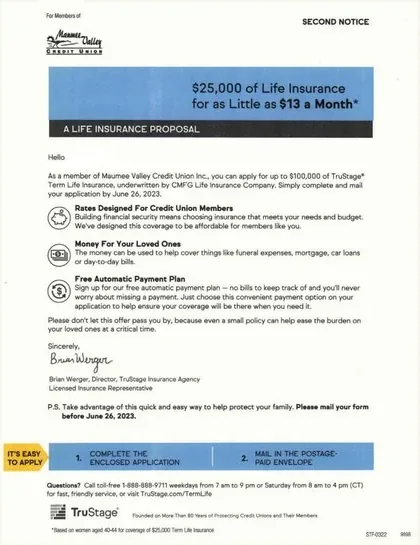
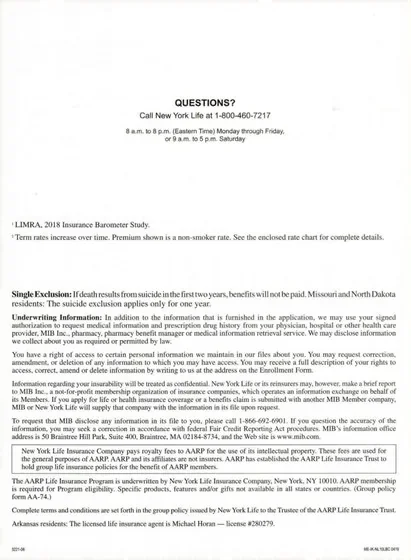
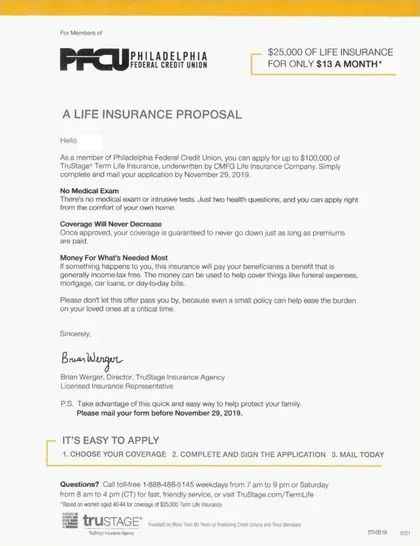
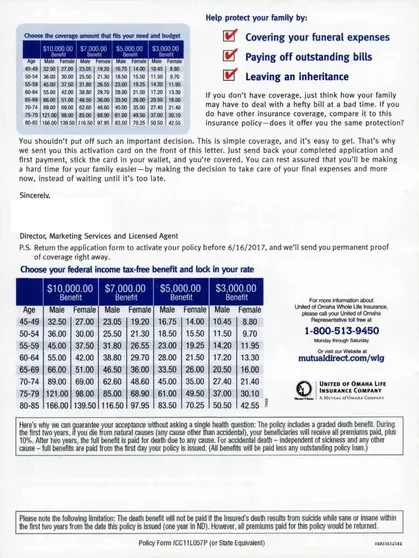
Source: Life insurance identity row plus clearly labeled Insurance parent-sector patterns from 2,213,774 eligible records. 2,213,652 records were analyzed; 122 were explicitly unknown. Analysis received August 15, 2026. The expanded catalog has 2,213,774 eligible physical-mail records; 2,213,652 were analyzed and 122 remain unknown. Industry tables cover 1,873,585 records with an assigned industry. Computer-assigned labels can contain errors.
The 18 most common life insurance mailers
See how common Life insurance mail packages the offer, proof, response path, and disclosures. Open any card to see every page. These are observed patterns, not performance rankings.
-
Blue benefit-summary life packet
White envelope and letter with a blue benefits summary, checklist, and reply path.
-
Term-life coverage offer with rate table
Branded envelope, price-led letter, red comparison table, and follow-up brochure.
-
Term-life proposal packet
Envelope and multi-page proposal with a pale blue panel, policy details, and response instructions.
-
Final-expense authorization packet
Dark envelope, authorization letter, benefit checklist, and premium table.
-
Direct-term affordability worksheet
Plain envelope and offer letter paired with a premium table and dense policy terms.
-
Yellow policy-information letter
Yellow stationery, formal correspondence, and a long explanatory letter.
-
Confidential policy notice packet
Confidential-marked envelope, red-accent notice, and detailed policy pages.
-
Preparedness and affordability packet
Dark envelope, readiness message, plan table, and supporting insert.
See all 18 common mailers
-
Term-life pricing comparison letter
Envelope, rate-comparison letter, and a detailed plan-selection page.
-
Member-benefit summary packet
Gold-accent envelope, explanatory letter, blue benefits summary, and response path.
-
Life-insurance rate-table mailer
Plain envelope, rate table, checklist, and question-and-answer insert.
-
Accidental-death coverage notice
Plain envelope, sign-and-return letter, and coverage summary with a benefit table.
-
Term-life proposal with comparison insert
Envelope, proposal letter, pale comparison insert, and response callout.
-
Term-life brochure and disclosure packet
White envelope, red-accent offer letter, and multi-column coverage brochure.
-
Term-life benefits comparison letter
Plain envelope, long comparison letter, and structured premium and benefit columns.
-
Policy-update and renewal packet
Envelope, policy-update letter, premium table, and dark terms insert.
-
Orange eligibility self-mailer
Bright orange self-mailer, eligibility letter, and signed response page.
-
Member term-benefit comparison packet
Plain envelope, blue rate table, benefit explanation, and enrollment guidance.
Each design groups similar mail pieces. The count covers the reviewed set, so the true total can be higher. A common design is not a proven winner.
Build a life insurance mailer like these. Send it this week.
Upload your list, design the piece, and see the exact cost before you send. Sendvo prints, mails, and tracks delivery.
What life insurance mail uses most
Share of pieces that include each element. One piece can include several, so rows add up to more than 100%.
Format
| Format | Bar | Share |
|---|---|---|
| Envelope + letter + inserts | 74.5% | |
| Envelope + letter/insert | 15.1% | |
| Folded self-mailer / short brochure | 7.8% | |
| Multi-page letter / brochure | 1.0% |
Offer
| Offer | Bar | Share |
|---|---|---|
| Price or payment | 89.4% | |
| Free | 74.4% | |
| Discount or savings | 60.1% | |
| Appointment or event | 28.1% |
Reason to trust the offer
| Reason to trust the offer | Bar | Share |
|---|---|---|
| Security or privacy | 58.9% | |
| Credentials or certification | 57.6% | |
| Guarantee or reduced risk | 46.8% | |
| Tenure or experience | 37.8% |
Way to respond
| Way to respond | Bar | Share |
|---|---|---|
| Phone | 94.9% | |
| Web address | 84.2% | |
| Apply or enroll | 67.8% | |
| Shop or order | 54.5% |
Scope: the insurance sector, not life-insurance-only. Not included: responses, sales, cost, or return on investment.
What does life insurance mail need to do?
A good piece helps its intended audience take one reasonable next step.
For an adult reviewing life insurance for a household, this piece helps them understand the offer and request a quote.
The job of the mail
Help a household decide whether to request a life-insurance quote or conversation.
The main problem
Underwriting surprise, dense booklets, and guaranteed-issue overclaim.
The safest first move
Use this first message plan: Cover type, face-amount example, underwriting note, action. Envelope + Letter + Inserts is the leading observed format at 74.5% in the insurance sector, not life-insurance-only. Choose it only when it fits the reading job.
Counts describe observed mail, not results. These figures are not response rates, conversion rates, lift, cost, or return on investment.
How big is the life insurance market in the data?
Start with the narrowest reliable market before you use a broad sector average.
Life is denser than health or auto. Do not brief it as a four-page quote card unless the offer is truly that simple.
Life insurance has 132,599 eligible pieces (27.6% of Insurance) and 132,597 analyzed records across 509 observed sender labels. Format, message-pattern, offer, proof, and response-path rates come from the insurance sector, not life-insurance-only, which has 479,853 eligible pieces.
Pieces found by market
See the market table and how to use it
| Market | Pieces | Share | Sender labels | What it means |
|---|---|---|---|---|
| Life Insurance | 132,599 | 27.6% | 509 | This page. Median 10 pages. |
| Health Insurance | 155,288 | 32.4% | 3,043 | Different object. |
| Term Life | 30,720 | 6.4% | 177 | Largest life subcategory. |
Use the narrowest reliable market row for the campaign. Parent-sector patterns stay labeled as parent context.
Who is the reader, and why now?
A useful message begins with a real reason for the mail to arrive now.
A real reason to arrive
parent reviewing term cover
A clear concern
a face amount that ignores underwriting
A small next step
Request a quote or call. Life mail is denser — plan the next step early anyway.
“For an adult reviewing life insurance for a household, this piece helps them understand the offer and request a quote.”
Use this sentence in the campaign brief. If it names several unrelated audiences, split the campaign.
See the computer-assigned audience and buying-stage labels
These labels come from words found in the mail. They do not come from verified mailing lists.
| Audience label | Pieces | Share |
|---|---|---|
| Homeowner Or Household | 267,257 | 55.7% |
| Existing Customer | 246,795 | 51.4% |
| New Prospect | 199,460 | 41.6% |
| Older Adult Or Retiree | 169,177 | 35.3% |
| Borrower Or Credit Seeker | 90,704 | 18.9% |
| Small Business | 86,800 | 18.1% |
| Traveler Or Guest | 40,690 | 8.5% |
| Donor Or Supporter | 17,411 | 3.6% |
| Lapsed Or Winback | 7,361 | 1.5% |
| Buying-stage label | Pieces | Share |
|---|---|---|
| Awareness Or Education | 405,878 | 84.6% |
| Consideration Or Comparison | 371,630 | 77.4% |
| Decision Or Action | 368,616 | 76.8% |
| Retention Or Cross Sell | 85,403 | 17.8% |
| Renewal or win-back | 62,794 | 13.1% |
How does life insurance mail start the conversation?
Use these patterns to understand the market. Do not copy them without a reason.
A message pattern is the order of the offer, proof, and next step. These patterns come from the insurance sector, not life-insurance-only. They show what appeared often. They do not show what worked.
Lead with a real incentive
Use when a bonus or gift is the reason to act.
Watch for: The bonus can hide fees or eligibility.Renew or win back a customer
Use when the reader already has a relationship.
Watch for: Sounds like cold acquisition if the account context is missing.Ask for a quote or a conversation
Use when the next step is a quote, not an application.
Watch for: A quote request that reads like enrollment.Explain first, then ask for one action
Use when this sequence fits better than the leading cluster.
Watch for: Interchangeable if you copy the category wholesale.See all message-pattern data
| Message pattern | Pieces | Share |
|---|---|---|
| Lead with an incentive | 350,448 | 73.0% |
| Renewal or win-back | 61,359 | 12.8% |
| Mission Or Donation Appeal | 18,826 | 3.9% |
| Quote or consultation | 12,140 | 2.5% |
| Explain, then ask for one action | 12,115 | 2.5% |
| Rate Led Financial Acquisition | 11,014 | 2.3% |
| Trust Led Education | 9,190 | 1.9% |
| Customer Cross Sell Or Service | 4,021 | 0.8% |
| Deadline Driven Offer | 718 | 0.1% |
Use the leading pattern as a control only when it matches the reader and the next step.
What formats do life insurance mailers use?
The leading format comes from the insurance sector, not life-insurance-only. It is not a performance result.
Envelope + Letter + Inserts
This is the leading format in the insurance sector, not life-insurance-only. Use it as a control only when the reader needs that amount of explanation.
Life insurance pieces have a median length of 10.0 pages and 1533.3 characters per page. Mean response-step complexity is 9.55; mean disclosure balance is 0.543.
Compare all observed format labels
These are computer-assigned format labels. They are not production specifications.
| Format label | Pieces | Share |
|---|---|---|
| Envelope + Letter + Inserts | 357,271 | 74.5% |
| Envelope + Letter/Insert | 72,272 | 15.1% |
| Folded Self-Mailer / Short Brochure | 37,265 | 7.8% |
| Multi-Page Letter / Brochure | 4,718 | 1.0% |
| Booklet / Catalog | 3,973 | 0.8% |
| Short Multi-Component Package | 3,259 | 0.7% |
| Single-Piece Mailer; Geometry Unavailable | 1,072 | 0.2% |
| Uncertain Physical Format | 1 | 0.0% |
What goes in each part of the package?
Each part of the package should answer one question for the reader.
Envelope
Show relevance. Do not place the full sales claim outside.
Opening
Name the reader and the reason for contact.
Offer
State term, face amount, underwriting in one clear reading path.
Proof
Use carrier strength, tenure, ratings, process explanation.
Next step
Request a quote or call. Life mail is denser — plan the next step early anyway.
Disclosures
Place an important limit near the claim that it changes.
See the observed page and component labels
| Page job | Pieces | Share |
|---|---|---|
| Exterior Or Lead Page | 479,830 | 100.0% |
| Ask for a response | 476,891 | 99.4% |
| Address a concern | 472,273 | 98.4% |
| State the offer | 464,460 | 96.8% |
| Give proof or reassurance | 437,584 | 91.2% |
| State limits or disclosures | 408,997 | 85.2% |
| Explain Or Support | 340,265 | 70.9% |
| Component | Pieces | Share |
|---|---|---|
| Letter | 429,543 | 89.5% |
| Outer Envelope | 429,543 | 89.5% |
| Insert Or Terms Pages | 365,962 | 76.3% |
| Reply Device | 156,494 | 32.6% |
| Voucher Coupon Or Certificate | 88,037 | 18.3% |
| Self Mailer Body | 37,265 | 7.8% |
| Card Carrier Device | 7,420 | 1.5% |
| Undetermined Component | 3,992 | 0.8% |
| Booklet Or Catalog Body | 3,973 | 0.8% |
How should the copy read?
The reader should not need life insurance expertise to understand the offer.
Write from the reader’s decision. Do not write from the company structure. Use common words. Define a specialist term the first time you use it.
Guaranteed coverage for anyone. No questions. Protect your family today.
If you want to review term or permanent life cover, request a quote or call. Any face-amount example is limited to the underwriting printed next to it.
Useful sentence patterns
- When [household situation], review [term / permanent] life cover with [face-amount example] and [underwriting note].
- Request a life-insurance quote: [type], [limit], [action].
See the observed message-sequence labels
| Message sequence | Pieces | Share |
|---|---|---|
| Offer → Next Step → Proof → Qualification | 32,455 | 6.8% |
| Offer → Next Step → Qualification → Proof | 18,471 | 3.8% |
| Next Step → Offer → Proof → Qualification | 17,612 | 3.7% |
| Offer → Next Step → Qualification → Proof → Problem | 14,977 | 3.1% |
| Proof → Offer → Next Step → Qualification | 14,445 | 3.0% |
| Offer → Proof → Next Step → Qualification | 14,427 | 3.0% |
| Proof → Qualification → Offer → Next Step → Problem | 12,022 | 2.5% |
| Offer → Next Step → Proof → Qualification → Problem | 11,547 | 2.4% |
| Offer → Qualification → Next Step → Proof | 11,177 | 2.3% |
| Proof → Offer → Next Step → Qualification → Problem | 10,685 | 2.2% |
| Next Step → Offer → Qualification → Proof | 10,528 | 2.2% |
| Offer → Proof → Qualification → Next Step | 9,962 | 2.1% |
| Proof → Next Step → Qualification → Offer → Problem | 8,912 | 1.9% |
| Proof → Next Step → Offer → Qualification | 8,521 | 1.8% |
| Offer → Next Step → Proof | 7,939 | 1.7% |
| Next Step → Offer → Qualification | 7,216 | 1.5% |
| Next Step → Proof → Offer → Qualification | 7,084 | 1.5% |
| Offer → Next Step → Qualification | 6,931 | 1.4% |
| Next Step → Offer → Proof → Qualification → Problem | 6,690 | 1.4% |
| Next Step → Qualification → Offer → Proof → Problem | 6,594 | 1.4% |
| Offer → Proof → Next Step → Qualification → Problem | 6,563 | 1.4% |
| Proof → Qualification → Offer → Next Step | 5,966 | 1.2% |
| Proof → Offer → Qualification → Next Step → Problem | 5,923 | 1.2% |
| Proof → Next Step → Offer → Qualification → Problem | 5,855 | 1.2% |
| Offer → Next Step | 5,850 | 1.2% |
| Next Step → Offer → Proof | 5,806 | 1.2% |
| Next Step → Offer | 5,753 | 1.2% |
| Offer → Next Step → Proof → Problem → Qualification | 5,589 | 1.2% |
| Next Step → Offer → Qualification → Proof → Problem | 5,583 | 1.2% |
| Proof → Offer → Next Step | 5,566 | 1.2% |
| Proof → Offer → Qualification → Next Step | 5,548 | 1.2% |
| Next Step → Qualification → Offer → Proof | 5,546 | 1.2% |
| Qualification → Offer → Next Step → Proof | 5,502 | 1.1% |
| Offer → Proof → Qualification → Next Step → Problem | 5,384 | 1.1% |
| Offer → Qualification → Next Step → Proof → Problem | 5,339 | 1.1% |
| Qualification → Offer → Next Step → Proof → Problem | 5,136 | 1.1% |
| Proof → Qualification → Next Step → Offer | 4,896 | 1.0% |
| Offer → Proof → Next Step | 4,761 | 1.0% |
| Offer → Qualification → Proof → Next Step | 4,753 | 1.0% |
| Proof → Next Step → Offer | 4,735 | 1.0% |
| Next Step → Proof → Offer → Qualification → Problem | 4,573 | 1.0% |
| Qualification → Offer → Proof → Next Step | 4,343 | 0.9% |
| Next Step → Proof → Offer | 3,934 | 0.8% |
| Qualification → Next Step → Offer → Proof | 3,711 | 0.8% |
| Proof → Offer → Problem → Next Step → Qualification | 3,642 | 0.8% |
| Proof → Next Step → Qualification → Offer | 3,588 | 0.7% |
| Proof → Offer → Next Step → Problem → Qualification | 3,401 | 0.7% |
| Qualification → Next Step → Proof → Offer | 3,350 | 0.7% |
| Proof → Qualification → Next Step → Offer → Problem | 3,296 | 0.7% |
| Offer → Next Step → Problem → Proof → Qualification | 2,979 | 0.6% |
What offers appear most in life insurance mail?
A clear offer states the value, the action, the timing, and who can use it.
Keep these four parts in one reading path. The offer becomes hard to understand when the reader must search for a limit or a deadline.
See offer and qualification data
| Offer label | Pieces | Share |
|---|---|---|
| Price Or Payment | 428,883 | 89.4% |
| Free | 357,239 | 74.4% |
| Discount Or Savings | 288,464 | 60.1% |
| Appointment Or Event | 134,627 | 28.1% |
| Reward Or Bonus | 62,688 | 13.1% |
| Rate Or APR | 31,436 | 6.6% |
| Bundle | 21,871 | 4.6% |
| Fee Waiver | 863 | 0.2% |
| Donation Match | 243 | 0.1% |
| Qualification level | Pieces | Share |
|---|---|---|
| High | 169,977 | 35.4% |
| Moderate | 152,028 | 31.7% |
| Low | 142,277 | 29.7% |
| None Or No Offer | 15,549 | 3.2% |
How does the mail make the offer believable?
Trust grows when a claim, its evidence, and its limit stay together.
What do you want the reader to believe?
What fact, credential, or process supports it?
What condition changes the meaning?
Assign an owner to every important claim before design begins. Keep the evidence file, the limit, and the approval date with the claim.
See proof and objection data
| Proof label | Pieces | Share |
|---|---|---|
| Security Or Privacy | 282,870 | 58.9% |
| Credentials Or Certification | 276,370 | 57.6% |
| Guarantee or reduced risk | 224,598 | 46.8% |
| Tenure Or Experience | 181,386 | 37.8% |
| Testimonial | 171,645 | 35.8% |
| Local Presence | 169,464 | 35.3% |
| Rating Or Award | 166,744 | 34.7% |
| Process Explanation | 48,821 | 10.2% |
| Product Or Service Detail | 43,184 | 9.0% |
| Customer Or Scale Count | 2,101 | 0.4% |
| Concern addressed | Pieces | Share |
|---|---|---|
| Price Or Affordability | 420,798 | 87.7% |
| Time Or Urgency | 417,855 | 87.1% |
| Eligibility Or Qualification | 321,081 | 66.9% |
| Risk Or Security | 300,821 | 62.7% |
| Trust Or Credibility | 291,629 | 60.8% |
| Effort Or Convenience | 261,357 | 54.5% |
| Switching Or Change | 124,644 | 26.0% |
| Commitment Or Contract | 26,484 | 5.5% |
How should the piece look?
Use layout to reduce uncertainty. Do not use decoration as proof.
Review the printed piece at its real size. Also hold it at arm’s length. Check it under normal household light.
See observed visual labels
A visual label means the system found an image idea near text. It is not a pixel measurement.
| Visual label | Pieces | Share |
|---|---|---|
| Image Led | 479,778 | 100.0% |
| People Or Lifestyle Text Adjacent | 342,971 | 71.5% |
| Product Or Service Text Adjacent | 278,453 | 58.0% |
| Diagram Or Comparison Text Adjacent | 203,114 | 42.3% |
| Copy Led | 40 | 0.0% |
| Balanced Image Copy | 12 | 0.0% |
When does personal data help?
Relevance comes from the reason for contact, not from a printed name alone.
Use personal data only when it is accurate, useful, and suitable for the message. Do not expose sensitive information on the envelope.
Connect each personal fact to a useful reason for contact. Create a safe fallback for every missing field. Print and check every variable version.
See observed personalization labels
| Personalization label | Pieces | Share |
|---|---|---|
| Local Or Geographic | 290,838 | 60.6% |
| Named Recipient Or Salutation | 277,238 | 57.8% |
| Product Specific Recommendation | 181,926 | 37.9% |
| Named Representative | 143,287 | 29.9% |
| Customer Or Account Context | 121,483 | 25.3% |
| Deadline Or Renewal Date | 115,999 | 24.2% |
| Unique Code Or Web Address | 25,964 | 5.4% |
| Selected Or Prequalified | 9,579 | 2.0% |
Named-recipient language is 57.8% of pieces and 14.8% on an equal-brand mean.
Large mailers can inflate the piece-weighted rate.
Name-on-the-letter is not a strategy.
How do readers respond?
Two response paths can work together when one is clearly primary.
94.9% in the insurance sector, not life-insurance-only. Observed frequency does not set its role in your brief.
84.2% in the insurance sector, not life-insurance-only. Choose one primary path for the campaign.
Quote or phone primary. Put the next step before page 10.
See response-path and next-step data
| Response path | Pieces | Share |
|---|---|---|
| Phone | 455,495 | 94.9% |
| Web Address | 404,180 | 84.2% |
| Apply Or Enroll | 325,181 | 67.8% |
| Shop Or Order | 261,501 | 54.5% |
| Reply Mail | 156,494 | 32.6% |
| Appointment Or Quote | 152,080 | 31.7% |
| Qr | 26,499 | 5.5% |
| Donation | 6,202 | 1.3% |
| Store Or Location | 2,623 | 0.5% |
| Main next step | Pieces | Share |
|---|---|---|
| Phone | 192,060 | 40.0% |
| Apply Or Enroll | 129,593 | 27.0% |
| Web Address | 77,969 | 16.2% |
| Shop Or Order | 39,062 | 8.1% |
| Appointment Or Quote | 30,044 | 6.3% |
| Reply Mail | 4,975 | 1.0% |
| None Detected | 3,055 | 0.6% |
| Qr | 2,002 | 0.4% |
| Donation | 820 | 0.2% |
| Store Or Location | 251 | 0.1% |
Where do disclosures belong?
A limit should explain a true claim. It should not rescue a misleading one.
The main claim must be true on its own. Place a material limit where the reader will see it with the claim.
Review these topics
- underwriting
- guaranteed-issue limits
- exclusions
- licensing
This guide is not legal or financial advice. It does not promise approval, eligibility, savings, coverage, or investment performance. The licensed firm owns its rates, terms, eligibility, and approval decisions.
See disclosure-balance data
| Disclosure balance | Pieces | Share |
|---|---|---|
| Promotion and limits are balanced | 284,587 | 59.3% |
| Promotion is more prominent | 90,084 | 18.8% |
| Disclosure Heavy | 78,472 | 16.4% |
| Little promotion or qualification | 26,688 | 5.6% |
When should life insurance mail arrive?
Plan from the in-home date. Use urgency only when the deadline is real.
Choose the date when the household should receive the mail.
Allow time to read, compare, and ask questions.
Use a real deadline only when the offer has one.
Keep the mailed promise in the quote page and call.
Plan from a real life event only if the list has it.
Time comparisons use only 1,242,943 records with a usable date (56.1459% of the eligible catalog). The remaining 970,831 records stay in full-catalog counts but do not enter time comparisons. Treat any time pattern as descriptive, not causal.
How do you stand out without overclaiming?
A strong difference helps the reader understand or trust the offer.
The largest senders can make a design choice look common. Compare the number of pieces with the number of sender labels that use the same choice.
Use one clear audience, useful proof, and one main response path.
A considered protection package. Density is a briefing fact, not a reason to hide the next step.
Do not use a louder claim only to look different.
See sender concentration measures
Parent evidence: the insurance sector, not life-insurance-only has 10,716 sender labels.
The ten largest sender labels in the insurance sector, not life-insurance-only account for 43.8% of pieces.
The largest sender label in the insurance sector, not life-insurance-only is UnitedHealthcare (16,164 pieces).
What does a practical first life insurance campaign look like?
Build a clear first version. Then change one item in each test.
- 01
Set the goal
Collect a life-insurance quote request or qualified call.
- 02
Write one audience sentence
For an adult reviewing life insurance for a household, this piece helps them understand the offer and request a quote.
- 03
Choose the first version
Lead with a real incentive is the leading observed message pattern at 73.0% in the insurance sector, not life-insurance-only. Use it only when it fits the reader and decision. Cover type, face-amount example, underwriting note, action.
- 04
Choose the package
Envelope + Letter + Inserts is the leading observed format at 74.5% in the insurance sector, not life-insurance-only. Choose it only when it fits the reading job.
- 05
Set the response path
Quote or phone primary. Put the next step before page 10.
- 06
Prepare proof and final checks
Carrier evidence with an owner. Claim ledger, underwriting placement, early next step, seed piece.
Change one item at a time
- Control: one cover type + underwriting note.
- Cell A: opening only.
- Cell B: proof only.
Final review checklist
Use this list before the piece goes to print.
Do
- Pick term or permanent for the control.
- Put underwriting next to the face amount.
- Plan for a longer package.
- Still place a next step in the first reading path.
- Label insurance-sector rates as parent.
- Assign a proof owner.
- Match the landing-page cover type.
- Inspect booklet folds and disclosure size.
- Start under FS&I.
- Keep health and auto on sibling URLs.
Do not
- Do not promise guaranteed issue unless true and limited.
- Do not hide underwriting.
- Do not brief this as health insurance.
- Do not treat 10 pages as a reason to delay the next step.
- Do not invent a trend.
- Do not link /solutions/insurance.
- Do not paste competitor copy.
- Do not claim lift.
- Do not run three product types in one control.
- Do not use name-only merge as strategy.
Questions a new reader may ask
These answers explain the data and its limits.
Does a high piece count mean this mail works?
No. A large catalog count shows what arrived, not what got a response, a sale, or a cheaper cost per result.
Does this page promise approval, eligibility, or savings?
No. Quotes, rates, coverage, approval, and eligibility stay with the carrier or lender. This page only describes catalog mail patterns and how to brief a control.
Are the format and offer rates from this vertical alone?
Only the identity row — piece count, share, brands, median pages, characters per page, response effort, and disclosure ratio — is this vertical. Format, message pattern, offer, next step, proof, and brand rates come from the parent sector and are labeled that way.
Why is life denser?
Median pages are 10, versus 4 for health and auto. That is a briefing fact, not a performance claim.
Are format and audience labels exact envelope specs?
No. Physical-format, audience, and next step labels are computer-assigned labels unless independently validated. They help you brief a test. They do not set a winning spec.
How to read the data
The appendix keeps the evidence visible. It also marks the limits of the research.
2,213,774 physical-mail records meet the archive’s eligibility rules; 2,213,652 were analyzed and 122 remain unknown.
1,873,585 records have an assigned industry. 340,189 do not and are excluded from industry tables.
1,242,943 records have a usable date (56.1459%). 970,831 remain undated.
There are no response, conversion, revenue, cost, lift, or return fields. A common pattern is not a proven winner.
Open the full appendix
| Page job | Pieces | Share |
|---|---|---|
| Exterior Or Lead Page | 479,830 | 100.0% |
| Ask for a response | 476,891 | 99.4% |
| Address a concern | 472,273 | 98.4% |
| State the offer | 464,460 | 96.8% |
| Give proof or reassurance | 437,584 | 91.2% |
| State limits or disclosures | 408,997 | 85.2% |
| Explain Or Support | 340,265 | 70.9% |
| Component | Pieces | Share |
|---|---|---|
| Letter | 429,543 | 89.5% |
| Outer Envelope | 429,543 | 89.5% |
| Insert Or Terms Pages | 365,962 | 76.3% |
| Reply Device | 156,494 | 32.6% |
| Voucher Coupon Or Certificate | 88,037 | 18.3% |
| Self Mailer Body | 37,265 | 7.8% |
| Card Carrier Device | 7,420 | 1.5% |
| Undetermined Component | 3,992 | 0.8% |
| Booklet Or Catalog Body | 3,973 | 0.8% |
| Message sequence | Pieces | Share |
|---|---|---|
| Offer → Next Step → Proof → Qualification | 32,455 | 6.8% |
| Offer → Next Step → Qualification → Proof | 18,471 | 3.8% |
| Next Step → Offer → Proof → Qualification | 17,612 | 3.7% |
| Offer → Next Step → Qualification → Proof → Problem | 14,977 | 3.1% |
| Proof → Offer → Next Step → Qualification | 14,445 | 3.0% |
| Offer → Proof → Next Step → Qualification | 14,427 | 3.0% |
| Proof → Qualification → Offer → Next Step → Problem | 12,022 | 2.5% |
| Offer → Next Step → Proof → Qualification → Problem | 11,547 | 2.4% |
| Offer → Qualification → Next Step → Proof | 11,177 | 2.3% |
| Proof → Offer → Next Step → Qualification → Problem | 10,685 | 2.2% |
| Next Step → Offer → Qualification → Proof | 10,528 | 2.2% |
| Offer → Proof → Qualification → Next Step | 9,962 | 2.1% |
| Proof → Next Step → Qualification → Offer → Problem | 8,912 | 1.9% |
| Proof → Next Step → Offer → Qualification | 8,521 | 1.8% |
| Offer → Next Step → Proof | 7,939 | 1.7% |
| Next Step → Offer → Qualification | 7,216 | 1.5% |
| Next Step → Proof → Offer → Qualification | 7,084 | 1.5% |
| Offer → Next Step → Qualification | 6,931 | 1.4% |
| Next Step → Offer → Proof → Qualification → Problem | 6,690 | 1.4% |
| Next Step → Qualification → Offer → Proof → Problem | 6,594 | 1.4% |
| Offer → Proof → Next Step → Qualification → Problem | 6,563 | 1.4% |
| Proof → Qualification → Offer → Next Step | 5,966 | 1.2% |
| Proof → Offer → Qualification → Next Step → Problem | 5,923 | 1.2% |
| Proof → Next Step → Offer → Qualification → Problem | 5,855 | 1.2% |
| Offer → Next Step | 5,850 | 1.2% |
| Next Step → Offer → Proof | 5,806 | 1.2% |
| Next Step → Offer | 5,753 | 1.2% |
| Offer → Next Step → Proof → Problem → Qualification | 5,589 | 1.2% |
| Next Step → Offer → Qualification → Proof → Problem | 5,583 | 1.2% |
| Proof → Offer → Next Step | 5,566 | 1.2% |
| Proof → Offer → Qualification → Next Step | 5,548 | 1.2% |
| Next Step → Qualification → Offer → Proof | 5,546 | 1.2% |
| Qualification → Offer → Next Step → Proof | 5,502 | 1.1% |
| Offer → Proof → Qualification → Next Step → Problem | 5,384 | 1.1% |
| Offer → Qualification → Next Step → Proof → Problem | 5,339 | 1.1% |
| Qualification → Offer → Next Step → Proof → Problem | 5,136 | 1.1% |
| Proof → Qualification → Next Step → Offer | 4,896 | 1.0% |
| Offer → Proof → Next Step | 4,761 | 1.0% |
| Offer → Qualification → Proof → Next Step | 4,753 | 1.0% |
| Proof → Next Step → Offer | 4,735 | 1.0% |
| Next Step → Proof → Offer → Qualification → Problem | 4,573 | 1.0% |
| Qualification → Offer → Proof → Next Step | 4,343 | 0.9% |
| Next Step → Proof → Offer | 3,934 | 0.8% |
| Qualification → Next Step → Offer → Proof | 3,711 | 0.8% |
| Proof → Offer → Problem → Next Step → Qualification | 3,642 | 0.8% |
| Proof → Next Step → Qualification → Offer | 3,588 | 0.7% |
| Proof → Offer → Next Step → Problem → Qualification | 3,401 | 0.7% |
| Qualification → Next Step → Proof → Offer | 3,350 | 0.7% |
| Proof → Qualification → Next Step → Offer → Problem | 3,296 | 0.7% |
| Offer → Next Step → Problem → Proof → Qualification | 2,979 | 0.6% |
| Visual label | Pieces | Share |
|---|---|---|
| Image Led | 479,778 | 100.0% |
| People Or Lifestyle Text Adjacent | 342,971 | 71.5% |
| Product Or Service Text Adjacent | 278,453 | 58.0% |
| Diagram Or Comparison Text Adjacent | 203,114 | 42.3% |
| Copy Led | 40 | 0.0% |
| Balanced Image Copy | 12 | 0.0% |
Source: Life insurance identity row plus clearly labeled Insurance parent-sector patterns from 2,213,774 eligible records. 2,213,652 records were analyzed; 122 were explicitly unknown. Analysis received August 15, 2026. The expanded catalog has 2,213,774 eligible physical-mail records; 2,213,652 were analyzed and 122 remain unknown. Industry tables cover 1,873,585 records with an assigned industry. Computer-assigned labels can contain errors.
Compare nearby markets
Want this report as a PDF?
Everything above stays free to read here. If you want a copy to share with your team, we will email the life insurance report as a PDF.