
Common examples of direct mail are postcards, personalized sales letters, dimensional mailers, coupon mailers, catalogs and brochures, self-mailers, reply cards and envelopes, postcard decks, magnets and specialty items, and event invitations. A real estate agent's just sold postcard, a dentist's appointment reminder, and a store's seasonal coupon are all direct mail.
There isn't one best format, because the job changes the format. A postcard has a different purpose than a letter, a dimensional mailer, or a reply envelope, and treating them as the same tool usually wastes budget and weakens measurement. The better question is which piece fits the audience, the offer, and the response path.
That's why the most useful examples of direct mail aren't just format samples, they're job assignments. Some pieces are built for fast visibility, some for detailed persuasion, some for appointment setting, and some for triggered follow-up after a specific event or behavior. The practical work is in matching the mailer to the outcome, then controlling the creative, production, and tracking around that choice.
Our research gives this format decision a stronger base than a small gallery of selected campaigns. Sendvo analyzed 1,873,585 industry-assigned physical-mail records across 15 sectors. The aggregate shows which creative patterns appeared in the catalog. It does not show which format caused a response or produced the best return.
Table of Contents
- What 1.87 Million Mail Records Show
- 1. Postcards
- 2. Personalized Sales Letters
- 3. Dimensional Mailers
- 4. Coupon and Offer Mailers
- 5. Catalog and Brochure Mailers
- 6. Self-Mailers
- 7. Response Cards and Reply Envelopes
- 8. Postcard Decks
- 9. Magnet and Specialty Item Mailers
- 10. Event Invitation and RSVP Mailers
- Can You Show Some Postcard Examples?
- What Is Considered Direct Mail?
- What Are the Disadvantages of Direct Mail?
- What Are the Best Direct Mail Platforms?
- Turn a Mail Format Into a Measurable Campaign
- Top 10 Direct Mail Formats Comparison
- Direct Mail Examples FAQ
- Sources
What 1.87 Million Mail Records Show
Sendvo analyzed 1,873,585 industry-assigned physical-mail records across 15 sectors. Envelope-and-letter proxies were common in this record-weighted catalog, while folded self-mailer or short-brochure proxies represented 12.3%. URLs appeared on 87.1% and phone paths on 85.4%. These frequencies describe observed creative patterns, not response, revenue, ROI, or a winning format.
| Observed pattern | Records | Share of records | Planning use |
|---|---|---|---|
| Envelope + letter + inserts proxy | 1,219,798 | 65.1% | Plan for a multi-part package and a controlled proof. |
| Envelope + letter/insert proxy | 325,121 | 17.4% | Plan the envelope and enclosed message as one reviewed piece. |
| Folded self-mailer or short-brochure proxy | 231,182 | 12.3% | Use when the message needs more space without an envelope. |
| URL response path | 1,631,075 | 87.1% | Give the recipient a clear digital next step. |
| Phone response path | 1,600,507 | 85.4% | Preserve a direct response path for callers. |
| Appointment or quote language | 436,854 | 23.3% | Match the call to action to a service decision. |
| QR code proxy | 122,260 | 6.5% | Treat QR as one optional path, not the only path. |
The labels come from automated creative-record classification. Labels can overlap and can contain errors. The catalog does not measure response, conversion, revenue, ROI, cost, causation, trends, or winners. See the Sendvo benchmarks and research method for the public methodology and limits.
1. Postcards
Postcards are the simplest direct mail format, and that's their strength. There's no envelope to open, so the offer is visible the moment the piece leaves the mailbox, porch, or stack of incoming mail. For local service businesses and real estate operators, that immediate visibility is often the whole point.
A postcard works best when the message is short, the offer is time-sensitive, and the response path is obvious. Real estate agents use them for neighborhood market updates, HVAC companies use them for seasonal tune-ups, automotive dealers use them for inventory or financing pushes, and insurance agents use them for policy reviews. USPS Notice 123 sets the maximum dimensions for Commercial First-Class Mail postcards at 6 inches high by 9 inches long, with thickness between 0.007 inch and 0.016 inch, which makes compliant production a practical design constraint, not a creative afterthought (USPS Notice 123 postcard sizing and pricing material).
Postcards do have trade-offs. They're fast to produce and easy to read, but they also make weak claims look even weaker, because there's no envelope to create curiosity or hide clutter. Keep the copy tight, put the offer first, and make the call to action impossible to miss.
Practical rule: If the offer needs more than a few seconds of reading, a postcard probably isn't the right format.
A clean postcard campaign usually includes one strong headline, one benefit, one response option, and one geographic rule for the audience. Map-based targeting is especially useful for this format, because the message often depends on neighborhood relevance rather than broad demographic reach. For teams that want to mail postcards online, Sendvo's postcard workflow is built around that kind of local execution, and its details are laid out in the postcards workflow page.
Read one postcard example from top to bottom
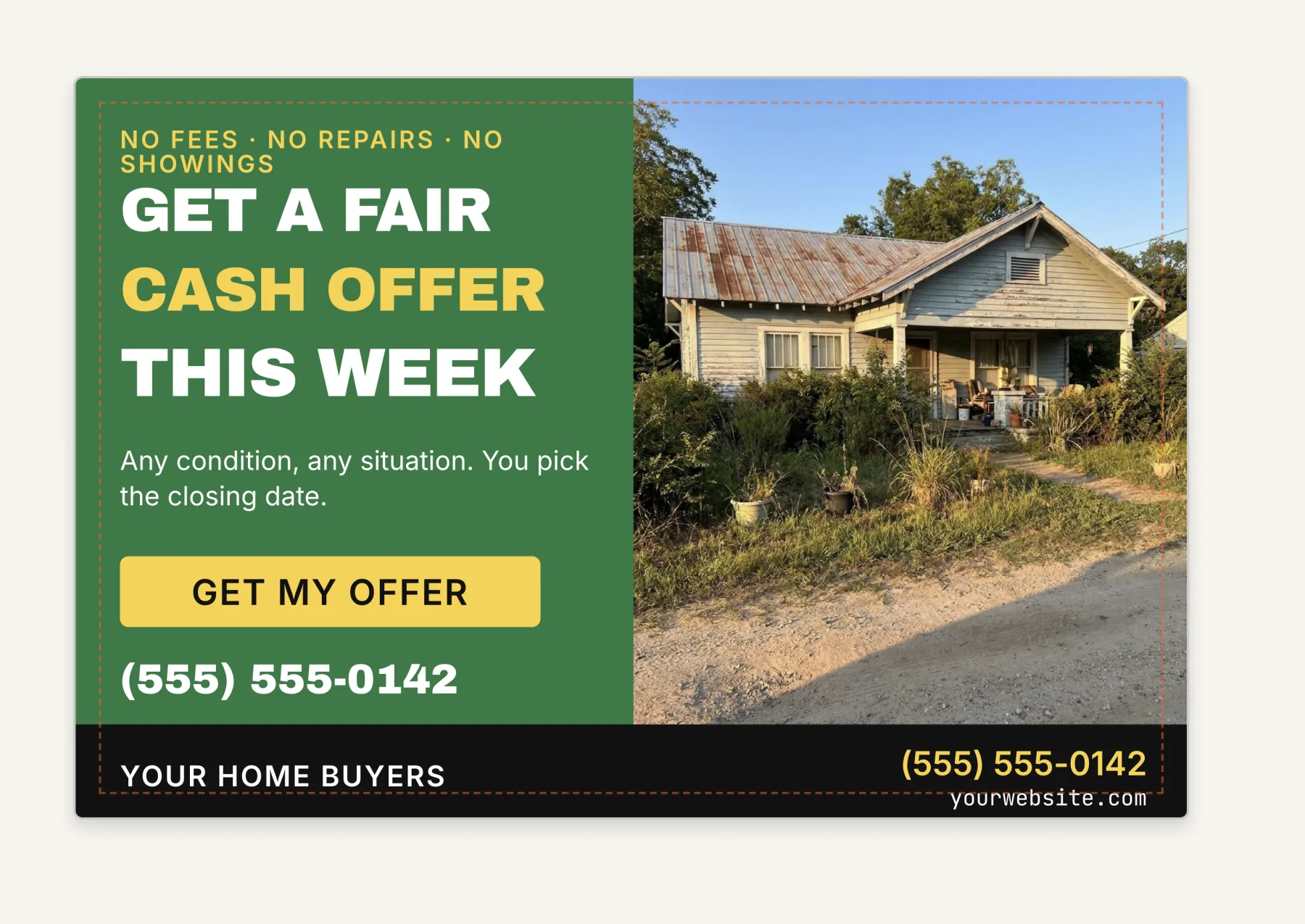
- Audience job: reach property owners in a selected market.
- Message hierarchy: one offer leads, with supporting detail below it.
- Response paths: phone and web options remain visible without competing headlines.
- Proof check: verify the offer text, contact details, image rights, trim area, and reverse-side postal space before approval.
2. Personalized Sales Letters
Sales letters are the right choice when the offer needs explanation, context, or trust. A letter lets you tell the story, show relevance, and ask for a more considered response without cramming everything into one card. That's why letters stay strong in higher-trust categories like financial services and healthcare, where recent benchmark data says they're the default format in compliance-heavy categories such as these, while brochures are favored in insurance and automotive (consumer insights on direct mail format fit).
Mortgage lenders, insurance agents, real estate investors, and B2B service providers all have reasons to use this format. A mortgage pre-approval letter can feel more serious than a postcard. A policy review letter can explain why the recipient should act now. A B2B introductory letter can make room for a short case study, a credibility statement, and a precise next step.
The operational challenge is density. Too many marketers stuff letters with background, boilerplate, and multiple asks, then wonder why response lags. Better letters use short paragraphs, plenty of white space, and a clear P.S. line that repeats the offer or deadline. That's where the reader's eye often lands first.
A strong letter also gives you a cleaner attribution setup than a generic mailer. You can pair merge tags with a unique offer code, then tie those responses back to the list segment and delivery window. Sendvo's personalization workflow is designed for that kind of variable-data execution, and the platform's personalization tools page reflects that use case.
Keep the tone human. A letter sounds expensive and credible when it reads like it was written for one person, not for a campaign calendar.
3. Dimensional Mailers
Dimensional mailers are the pieces people keep talking about because they don't feel like standard mail. Boxes, tubes, padded envelopes, rigid mailers, and small merchandise packages all create more curiosity than a flat piece can. That makes them useful when the prospect is high-value and the message has to justify more attention than a standard envelope earns.
Insurance agents sometimes send branded gift items with policy-benefit mailers. Real estate agents may include merchandise with property market reports. Automotive teams use premium items around lease offers, and home services companies sometimes include branded tools or safety items with service messaging. The point isn't gimmickry, it's memorability. The physical object signals that the sender expects a serious look.
The trade-off is cost and lead time. Dimensional mailers take more planning, more production coordination, and a tighter targeting strategy, because the per-piece spend is harder to justify on a low-value audience. If the list isn't carefully screened, the format can become an expensive novelty instead of a revenue lever.
Here, the creative should stay disciplined. The object should reinforce the offer, not distract from it. If the recipient has to unpack layers of packaging just to understand the point, the campaign has already started losing momentum. The best dimensional pieces are simple to open, easy to brand, and easy to respond to.
Sendvo's browser-based proofing workflow is relevant for this kind of production-heavy campaign, especially when multiple versions need approval before anything goes to press. The design studio and proofs page is the right place to see how that review step fits into a direct-mail process.
A USPS case study for Priority Mail Flat Rate boxes reported a 53% increase in sales volume, a 46% increase in product revenue, and an ROI of 107%. The campaign also exceeded response goals by 54%, and recipient preference data showed mail captured 79% of responses versus 5% for QR codes and 15% for URLs (USPS promotional case study). That kind of result is why dimensional mailers remain a selective but serious option.
4. Coupon and Offer Mailers
Coupon and offer mailers are built for one job, getting the reader to redeem something. They work when the value is obvious, the deadline is real, and the response path is friction-light. If the offer is too vague, the format loses its advantage fast.
These pieces show up everywhere because the economics are easy to understand. HVAC and plumbing companies mail seasonal discounts, restaurants send percentage-off or free-item coupons, retail stores push loyalty offers, and automotive service departments use coupons to drive maintenance visits. The strongest versions make the discount the visual focal point, then support it with a redemption code, QR code, phone number, or URL.
The best coupon mailers are honest about the trade-off. A deeper discount can lift response, but it can also compress margin. That's why the operator has to test offer levels, control exclusions, and watch whether redemptions align with delivery windows instead of just inflating on-paper interest.
A practical setup looks like this.
- Make the value obvious: Put the discount or free item where the eye lands first.
- Use one deadline: Urgency works when it's specific, not when it feels generic.
- Track each batch: Unique codes make it easier to tie redemption to list segment and mailing wave.
- Protect margin: Set stacking rules, exclusions, and per-customer limits before launch.
Direct mail consumers still engage quickly. Recent consumer-insight reporting says 84% of consumers read mail immediately or the same day, and 85% of Gen Z and Millennials engage with direct mail (consumer insights report). That doesn't mean every coupon mailer wins, but it does mean the format still gets seen.
For retail-oriented teams, Sendvo's retail direct mail resource is a relevant workflow reference for offer-heavy pieces that need clear tracking and straightforward production.
5. Catalog and Brochure Mailers
Catalogs and brochures are the right answer when the buyer needs to compare, browse, or learn. A postcard can announce, but it can't explain a product line. A catalog can show range, structure categories, and keep the brand on the desk or kitchen counter long enough for a second look.
E-commerce retailers use seasonal catalogs, home improvement and furniture brands use brochure-style mailers for collections, B2B distributors use product catalogs to support account managers, and insurance companies use brochures to unpack coverage options. This format works because it respects how people buy complex offers, with comparison, not just impulse.
The production risk is bloat. Too many catalogs read like a dumping ground for every SKU or service line. The better approach is editorial. Lead with the best sellers or strongest margin drivers, then organize the rest in a way that helps the reader move from interest to action. Photos should do real work, not decorate empty space.
Catalogs also create a longer life cycle than a one-off promotion. They can sit around as reference material, which is valuable when the buyer isn't ready to respond right away. That makes them a better fit for warm audiences, previous customers, and prospects who need a little more proof before they act.
A catalog earns its keep when the reader can return to it later and still understand what to do next.
If you're using a broader service stack, Sendvo's direct mail services overview fits naturally here because catalog-style campaigns often need audience control, proofing, and delivery tracking in the same workflow. The question is not whether a catalog looks impressive, it's whether the structure helps the prospect choose faster.
6. Self-Mailers
Self-mailers are folded or multi-panel pieces that don't need a separate envelope. That makes them practical for volume campaigns where cost control matters, but you still want more space than a postcard gives you. The fold adds a little suspense, which helps when the message needs more room to unfold.
Real estate agents use tri-fold neighborhood market updates, event organizers use folded invitations and program details, home services companies use folded promotions, and nonprofits use donation pieces with impact stories. These are good examples of direct mail because the format balances production efficiency with a more deliberate reading experience. It's still direct mail, but it doesn't feel as compressed as a postcard.
The design trade-off is obvious. You have to think in panels, not just in one visual canvas. Text can disappear into folds, margins can get chopped, and the piece can become awkward if the layout fights the format. That's why physical samples matter before a final print run goes out.
A good self-mailer gives the front panel a reason to be opened and the back panel a reason to act. The copy should stay concise, because the available space is limited and each panel has to work. Specialty folds can help, but only when the mailing volume justifies the added production complexity.
Design for the fold, not around it. A layout that ignores the fold usually reads like a brochure that got forced into the mail.
7. Response Cards and Reply Envelopes
Response cards and reply envelopes are all about reducing friction. If a prospect has to hunt for contact details, the campaign has already made the next step too hard. These tools make it easy to say yes, request information, opt in, or confirm attendance without extra effort.
Insurance quotes, mortgage pre-approval mailings, charitable appeals, and property inquiry letters all benefit from this structure. A response card can be torn out and sent back, while business reply mail removes the postage barrier entirely. USPS guidance identifies CASS as the Coding Accuracy Support System, used to certify address-matching software, and describes NCOALink as a secure data product that helps identify move updates and deliverable addresses by matching mailing lists against change-of-address information (USPS address-quality and correction guidance). That matters because response pieces only work well when the underlying list quality is clean.
The practical problem is that many teams treat the reply device like a formality. They tuck it inside the mailer, bury the instructions, or leave the response path vague. Response tools work best when the card is prominent, the steps are obvious, and the back-end system is ready to log and match replies against the mailing record.
Clear tracking improves this format a lot. A unique code or barcode lets you connect a returned card to the original audience segment, which makes attribution more trustworthy than guessing from inbound volume alone. A good response setup doesn't just collect replies, it proves which list and offer generated them.
8. Postcard Decks
Postcard decks are a useful reminder that direct mail can be shared. Instead of one piece per household, a deck bundles multiple offers together so the recipient can flip through options and tear out the card that matters. That structure makes sense when the audience is narrow and the senders are sharing distribution.
Local service providers, luxury real estate agents, automotive service centers, restaurants, and tourism-focused businesses all use deck-style formats because they benefit from repeated exposure inside one mailing. The appeal is obvious. Each participant gets visibility, the audience stays targeted, and the cost is shared across multiple businesses.
The weak point is adjacency. If the deck includes competitors or unrelated offers, your message can get diluted. Audience fit has to be tight, and the publisher's distribution practices have to be clear. A deck that reaches the wrong homes at the wrong time is just a bundled expense.
Creative needs to respect the format constraints. The card has limited space, so the visual hierarchy has to be sharp. A strong headline, one offer, one response method, and a unique code are usually enough. Anything more starts to compete with neighboring cards instead of standing out from them.
The best deck campaigns are selective, not generic. They work because the audience is already concentrated around a category, like home services or local dining, and each participating business benefits from that context. If the deck publisher can't clearly explain distribution area, timing, and response tracking, the campaign is probably too loose to trust.
9. Magnet and Specialty Item Mailers
Magnet and specialty item mailers are built for stay-power. The recipient keeps the item because it has a use, and that means the brand message survives longer than a one-time piece usually does. Refrigerator magnets, calendars, notepads, pens, seed packets, and bookmarks all fit this pattern.
Real estate agents use refrigerator magnets with contact details and market insights. HVAC and plumbing companies mail calendars or notepads to homeowner neighborhoods. Insurance agents send pens with contact information, and automotive dealers use branded items for owner lists. The utility of the item matters more than novelty, because a gimmick gets tossed and a helpful item gets kept.
The trade-off is production timing and relevance. These pieces often need longer lead times, and if the item doesn't fit the audience, the keep rate drops with it. A pen can be useful in business contexts, but it may not be the right item for every homeowner list. A magnet is practical for some audiences and forgettable for others.
The smartest approach is to choose items people already use in the setting you're targeting. Homeowners may keep a fridge magnet or calendar. Business buyers may keep a pen or notepad. The branding has to be legible, the contact details have to be clear, and the call to action has to survive months of use.
A specialty item works best when the brand is part of a routine. If the object stays in sight, the message stays in memory.
10. Event Invitation and RSVP Mailers
Event invitation mailers are direct response pieces with a deadline. They need to move the recipient from awareness to attendance, whether the event is an open house, webinar, workshop, networking event, campus visit, or seasonal sale. Because the job is specific, the creative should be specific too.
Real estate agents mail open house invitations to nearby neighborhoods, educational institutions send campus open house pieces to prospects, B2B companies invite industry lists to workshops and webinars, and automotive dealers promote showcase events or special sales. The format works when the attendance value is obvious and the RSVP method is friction-light.
Timing is critical. If the mail arrives too late, the recipient can't plan. If it arrives too early without a second touch, it gets forgotten. The mailer should include date, time, location, and one clear reason to show up, not just a generic invitation. QR codes, registration URLs, phone numbers, and tear-out reply cards all work, but the piece still needs one primary path.
The strongest invitation mailers read like a benefit promise, not a calendar notice. “Learn more” is weak. “Discover five neighborhood trends before you list” is stronger because it tells the recipient what they get by attending. That distinction matters in crowded markets where every extra step lowers attendance.
A good event mailer is also easier to measure than a broad awareness piece. You can track RSVPs, compare source codes, and measure attendance against confirmed delivery windows, which makes it one of the more attribution-friendly direct mail formats.
Can You Show Some Postcard Examples?
Good postcard examples pair one real moment with one offer: a just sold card for homeowners near a recent sale, a seasonal tune-up card from an HVAC company, a welcome card for new movers, a win-back card for lapsed customers, and a service reminder from an auto shop or dental office.
| Postcard example | Who sends it | Offer and response path | Guide |
|---|---|---|---|
| Just sold | Real estate agents | Neighborhood valuation review with a QR code per farm | Just sold postcard examples |
| Seasonal tune-up | HVAC and home services | Dated service offer with a booking phone number | HVAC direct mail |
| New mover welcome | Local services, retail, healthcare | First-visit offer with a unique code | New mover mailing list |
| Abandoned cart or win-back | Ecommerce brands | Product image and a personal discount code | Abandoned cart postcards |
| Service reminder | Auto shops and dental offices | Due-date reminder with an appointment link | Service reminder postcards |
| Grand opening or neighborhood offer | Restaurants and local stores | Opening offer mailed to every home on nearby routes | Every Door Direct Mail |
To turn one of these into a real campaign, pick a size and layout in the postcard design templates guide, then send postcards online with a proof and the full per-piece cost shown before you approve.
What Is Considered Direct Mail?
Direct mail is printed marketing or fundraising material sent through the postal service to a person, a household, or every address on a route. Postcards, letters, catalogs, self-mailers, and coupon packs all count. Bills, statements, and personal letters are mail, but they are not usually called direct mail because they are not sent to promote something.
Direct mail comes in two broad types. Targeted mail goes to a list of named people or specific addresses, such as past customers or homeowners in a farm area. Saturation mail, such as USPS Every Door Direct Mail, goes to every address on selected carrier routes without names. For a side-by-side comparison, see EDDM vs. targeted direct mail.
What Are the Disadvantages of Direct Mail?
The main disadvantages of direct mail are cost per piece, lead time, and measurement effort. Each piece has a print and postage cost that email does not have, campaigns take days to produce and deliver, and results are hard to read unless every campaign has its own code, URL, or phone number.
- Cost per piece: printing and postage add up quickly on large lists. See how much direct mail costs for typical ranges.
- Lead time: design, proofing, printing, and USPS delivery take time, so mail is weak for same-day offers.
- Wasted pieces: stale or duplicate addresses cost money without reaching anyone. Clean the list with list hygiene before each drop.
- Measurement: a response can come weeks later through a phone call or store visit. Plan the measurement window before you mail.
What Are the Best Direct Mail Platforms?
The best direct mail platform depends on who sends the mail. Self-service platforms suit small teams that want to build an audience, design a postcard, and see the price in one dashboard. API-first providers suit developers who build mail into their own software. Full-service mail houses and agencies suit teams that want someone else to run the campaign.
Compare platforms on the total per-piece price including postage, address checks, proof review, tracking, and minimum order size. For shortlists, see the best self-service direct mail platforms, the best postcard mailing services, and the direct mail API guide. Sendvo is a self-service platform with a free Local plan and no minimum order; current rates are on the pricing page.
Turn a Mail Format Into a Measurable Campaign
Start with the job, not the format. If the goal is immediate local visibility, a postcard usually makes sense. If the goal is explanation or trust, a letter or brochure is a better fit. If the goal is high-value attention, a dimensional piece or specialty item may earn the extra spend. If the goal is attendance or redemption, a response device, coupon, or invitation gives you a cleaner path to action.
The strongest campaigns control the same few variables every time. The audience has to be specific, the offer has to match the format, the creative has to stay concise, and the response path has to be obvious. List quality matters just as much, which is why suppression, deduplication, and address verification should happen before postage is spent. USPS says CASS certifies address-matching software and NCOALink helps identify move updates and deliverable addresses, so address controls aren't optional overhead, they're part of the campaign's economics (USPS address-quality guidance).
Measurement works better when you use offer-specific identifiers and confirmed delivery windows instead of relying on broad assumptions. The USPS Intelligent Mail barcode is designed to encode routing and tracking information for automated processing and tracking, and USPS describes it as 65 vertical bars representing four states with 31 digits split into a 20-digit tracking code and an 11-digit routing code when required (USPS Intelligent Mail barcode definition). That's the kind of infrastructure that makes mail measurable in a way many people still underestimate.
The practical pattern is simple. Build one version, test a small batch, approve the proof, monitor delivery, then compare responses against the actual in-home window. If the creative is too crowded, trim it. If the offer is too vague, sharpen it. If the list is noisy, suppress and deduplicate it before the next drop.
Sendvo fits this kind of workflow when teams need map- or list-based audiences, browser proofs, all-in per-piece credit totals, address controls, IMb tracking, reusable campaigns, and webhook-triggered sends. It's most useful when the mailing process has to stay visible from audience selection through delivery history, not just from upload to print. For teams that want to manage direct mail with a single operational workflow, pair it with a clear direct mail attribution plan so each format is judged on responses, not impressions.
Top 10 Direct Mail Formats Comparison
| Format | Implementation complexity | Resource requirements | Expected outcomes | Ideal use cases | Key advantages |
|---|---|---|---|---|---|
| Postcards | Low, simple single- or double-sided layout | Minimal: print, postage, USPS-compliant sizing, basic personalization | High visibility and quick responses for time-sensitive offers | Promotions, event announcements, geographic targeting | Lowest per-piece cost, immediate message visibility, fast turnaround |
| Personalized Sales Letters | Medium, tailored copy and envelope preparation | Branded letterhead, envelopes, multi-page printing, merge tags | Higher perceived value and deeper engagement for complex offers | High-value B2B, consultative sales, pre-approvals | Formality and credibility, privacy of envelope, detailed storytelling |
| Dimensional Mailers | High, custom packaging and fulfillment logistics | Custom boxes/tubes, product samples, higher postage (First-Class/Priority), fulfillment | Very high open/engagement rates, strong memorability and ROI for targeted lists | Premium prospects, product sampling, executive outreach | Memorable unboxing, experiential impact, high conversion potential |
| Coupon and Offer Mailers | Low–Medium, clear offer design plus tracking | Unique codes/barcodes, QR links, backend redemption tracking, print/postage | Direct, measurable redemptions and short-term conversions | Retail, restaurants, home services, acquisition promotions | Drives immediate action, easy attribution with codes, highly trackable |
| Catalog and Brochure Mailers | High, extensive design, photography, and binding | Multi-page printing, high-quality imagery, longer lead times and inventory accuracy | Comprehensive product education, longer-term engagement, reference use | E-commerce, seasonal collections, complex product lines | Deep product showcase, builds brand authority, kept as reference |
| Self-Mailers | Medium, multi-panel/folded design considerations | Single-piece printing with folds, panel design, USPS compliance | Moderate engagement; creates curiosity through folding and reveal | Announcements, event invites, product updates, mid-volume campaigns | Lower cost than envelopes, faster turnaround, creative multi-panel layout |
| Response Cards & Reply Envelopes | Medium, tracking and BRM setup required | Perforated cards, BRM envelopes/indicia, backend processing for responses | Increased response rates and improved attribution (physical replies) | Donations, quotes, RSVP-driven campaigns, lead capture | Removes friction, enables accurate tracking, higher completion rates |
| Postcard Decks | Medium, coordination with multiple participants/publisher | Shared production and mailing, deck binding, perforations, publisher management | Cost-shared distribution, extended engagement, targeted segmented reach | Local/regional campaigns, small businesses, home services marketing | Lower per-card cost, targeted audiences, multi-offer exposure |
| Magnet & Specialty Item Mailers | Medium–High, item sourcing and integration | Custom item production (magnets, calendars), durable materials, longer lead times | Long-term brand visibility and higher keep rates | Real estate, contractors, local service businesses | Repeated exposure over time, practical utility, strong retention |
| Event Invitation & RSVP Mailers | Medium, timing and RSVP logistics important | Premium design options, RSVP mechanisms (QR, tear-out cards), tracking | Higher intent to attend, measurable RSVPs and attendance forecasting | Open houses, workshops, product launches, B2B events | Drives attendance, clear CTA with deadline, effective for planned events |
Direct Mail Examples FAQ
What are some direct mail examples?
Common direct mail examples include postcards, personalized sales letters, dimensional mailers, coupon mailers, catalogs and brochures, self-mailers, reply cards, postcard decks, magnets, and event invitations. Everyday examples are a just sold postcard from a real estate agent, a service reminder from an auto shop, and a seasonal coupon from a local store.
What is the most common type of direct mail?
In the 1,873,585 industry-assigned mail records Sendvo analyzed, envelope-and-letter packages were the most common pattern in that sample: 65.1% matched an envelope, letter, and inserts proxy, and another 17.4% matched an envelope with a letter or insert. For small businesses sending their own campaigns, postcards are usually the simplest place to start.
Is a postcard or a letter better for direct mail?
A postcard is better for short, time-sensitive offers that should be seen without opening anything. A letter is better when the offer needs explanation, privacy, or trust, such as financial, insurance, or healthcare messages. Test the format against the same audience before switching everything.
How much does it cost to send a direct mail postcard?
On Sendvo, a 4×6 postcard to a targeted list costs $0.92 on the free Local plan, including printing, postage, address verification, and tracking. Every Door Direct Mail postcards cost $0.65 each on every plan.
Sources
- Sendvo benchmarks and original research method
- USPS promotional case study for Priority Mail Flat Rate boxes
- USPS Notice 123 postcard sizing and pricing material
- Lob State of Direct Mail 2025 consumer insights report
- USPS address-quality and correction guidance
- USPS PostalPro: Intelligent Mail barcode
- USPS: Every Door Direct Mail
- Sendvo pricing
- Sendvo postcards workflow
- Sendvo personalization tools
- Sendvo design studio and proofs
- Sendvo retail direct mail resource
- Sendvo direct mail services overview
If you're planning your next mailing, use Sendvo to build the audience, approve the proof, and track the delivery window in one workflow. It's a practical fit for postcards, letters, and triggered campaigns when you want clearer control over cost, address quality, and response timing.
Turn the workflow into a Sendvo campaign.
Build the audience, review the postcard proof, see the exact credit cost on the live rate card, and release the campaign from one self-service workflow.