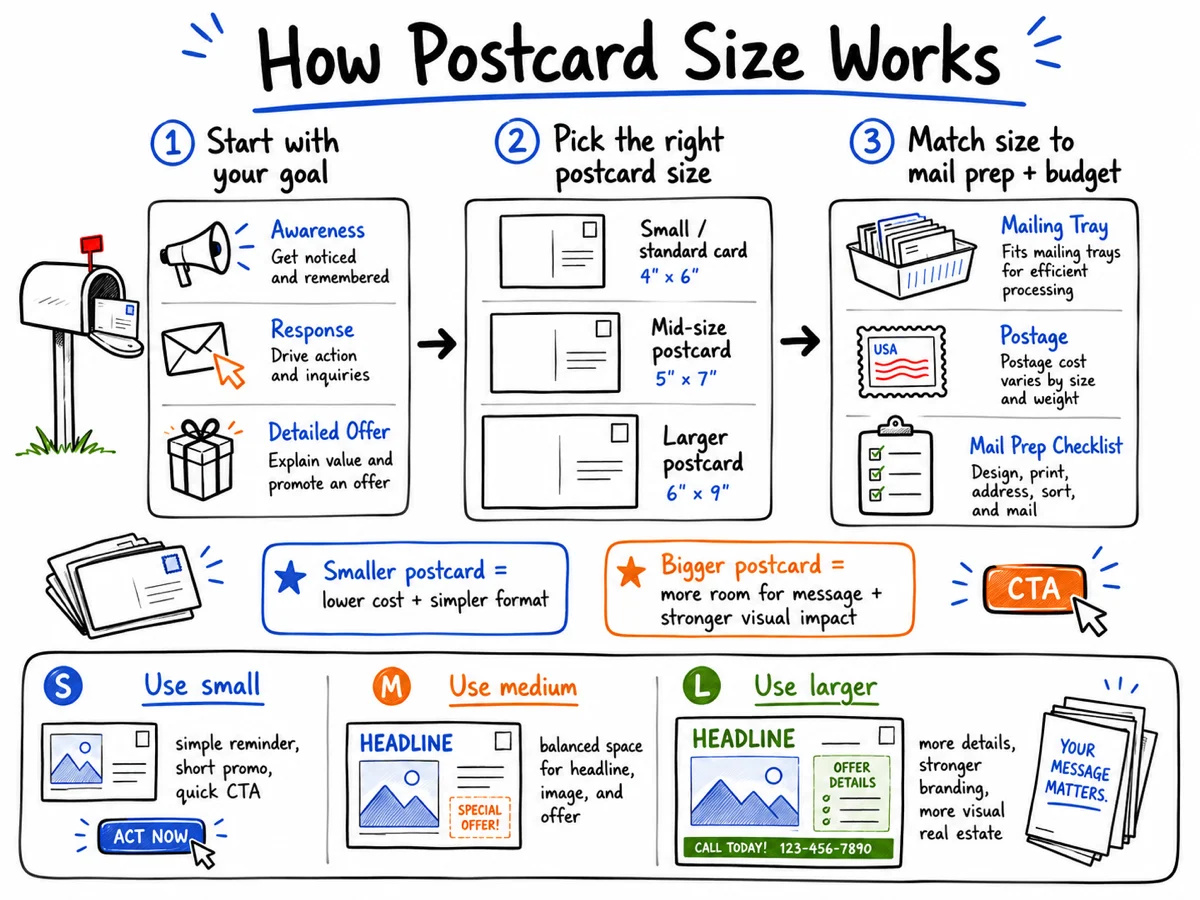
What are the standard postcard sizes?
The common postcard sizes on print and mailing menus are 4 × 6, 4.25 × 6, 5 × 7, 6 × 9, and 6 × 11 inches. Only cards up to 4.25 × 6 inches get the standard First-Class Mail postcard price. Commercial presorted First-Class mail extends that to 6 × 9. A 6 × 11 card mails as a letter.
The table below measures each size against the USPS rules covered in the rest of this guide. USPS measures length along the side parallel to the address and height along the side perpendicular to it, so a 6 × 9 card is 6 inches high and 9 inches long.
| Size (inches) | USPS size category | First-Class postcard price? | Typical use |
|---|---|---|---|
| 3.5 × 5 | Card (USPS minimum) | Yes, 0.007–0.016 in thick | Reply cards, short notes |
| 4 × 6 | Card | Yes, 0.007–0.016 in thick | Reminders, appointment notices, one-offer promotions |
| 4.25 × 6 | Card (standard maximum) | Yes, 0.007–0.016 in thick | The largest card that gets the standard postcard price |
| 5 × 7 | Letter | Only as commercial presorted or automation First-Class Mail, 0.009–0.016 in thick | Announcements, invitations, event mailers |
| 6 × 9 | Letter | Only as commercial presorted or automation First-Class Mail, 0.009–0.016 in thick | Marketing postcards with an image, offer, and response path |
| 6 × 11 | Letter | No. It is priced as a letter | Larger marketing postcards; also meets the EDDM length rule |
| 6.25 × 9, 6.25 × 11, 8.5 × 11 | Flat | No. It is priced as a flat | Every Door Direct Mail (EDDM) and other flat-size mailers |
Paper thickness matters as much as the trim size. A card that is too thin or too thick for its category can lose the price you planned for, so confirm the stock with your printer before approving a proof.
What are the USPS postcard size requirements?
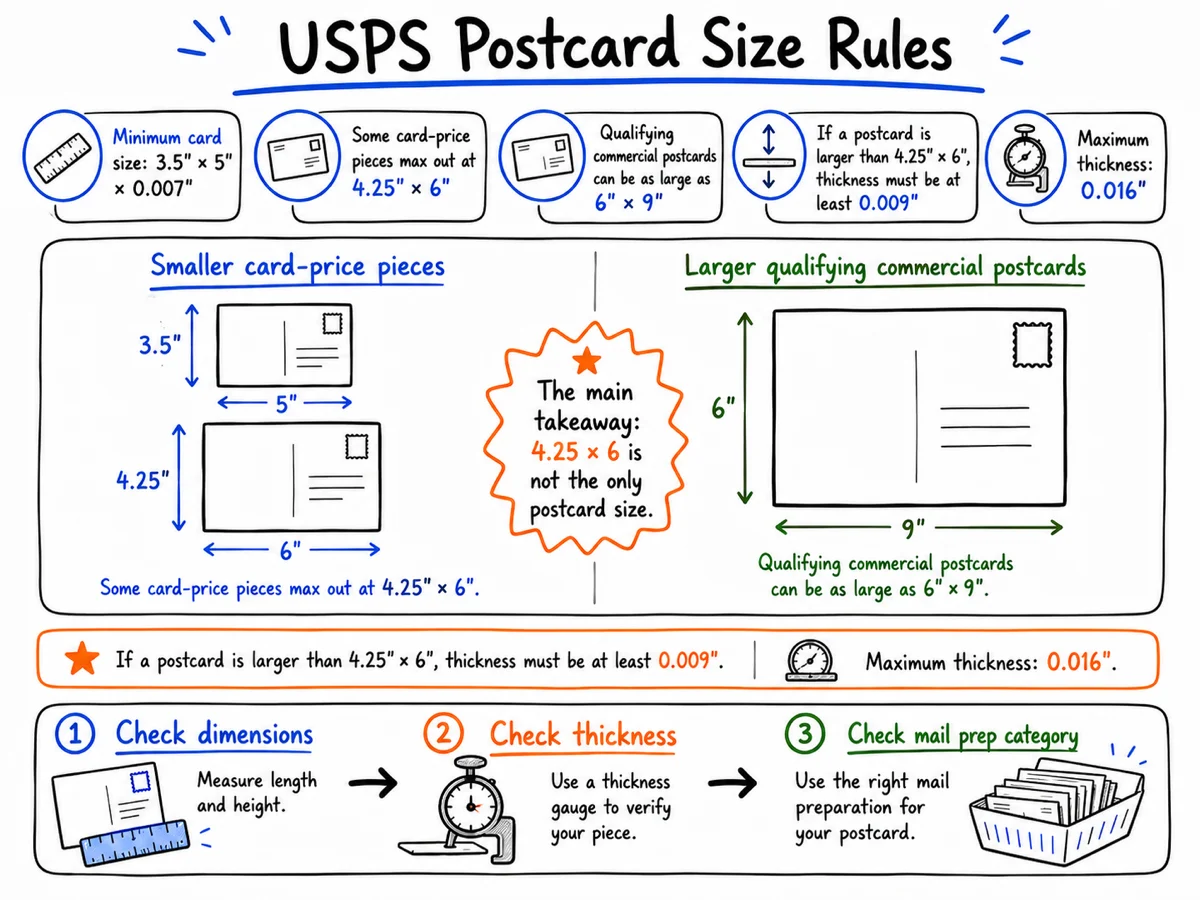
To mail at the First-Class Mail postcard price, a card must be rectangular, at least 3-1/2 inches high × 5 inches long × 0.007 inch thick, and no more than 4-1/4 inches high × 6 inches long × 0.016 inch thick. If a card falls outside those limits, USPS treats it as a letter and charges letter-size postage.
The USPS requirements for card pricing, in plain terms:
- Minimum size: 3-1/2 × 5 inches and 0.007 inch thick.
- Maximum size: 4-1/4 × 6 inches and 0.016 inch thick. Commercial presorted and automation First-Class Mail postcards can be up to 6 × 9 inches (see the next section).
- Shape: rectangular.
- Material: uniform thickness, made of unfolded and uncreased paper or cardstock.
- Attachments: USPS restricts attachments, and some can disqualify a card from the First-Class postcard price.
Can a 6 × 9 postcard mail at the postcard price?
Yes, if it is mailed as a commercial presorted or automation First-Class Mail postcard. USPS raised the maximum size for those postcards to 6 inches high × 9 inches long. Cards larger than 4-1/4 × 6 inches must be 0.009 to 0.016 inch thick. The 0.007 inch minimum still applies to smaller cards.
This is why "6 × 9 postcard" can mean two different prices. A business mailing a presorted First-Class batch can get card pricing. The same card dropped at a retail counter or mailed as USPS Marketing Mail is priced as a letter. Ask your mailing service which class and preparation your pieces use before you compare quotes.
When does a postcard mail as a letter or a flat instead?
A postcard stops getting the postcard price once it is larger than the card maximum. Up to 6-1/8 inches high, 11-1/2 inches long, and 1/4 inch thick, it mails as a letter. Go past any one of those limits and it becomes a flat, up to 12 × 15 inches and 3/4 inch thick.
| Category | Height | Length | Thickness |
|---|---|---|---|
| First-Class postcard (standard) | 3-1/2 to 4-1/4 in | 5 to 6 in | 0.007 to 0.016 in |
| First-Class postcard (commercial presorted or automation) | Up to 6 in | Up to 9 in | 0.009 to 0.016 in above 4-1/4 × 6 |
| Letter | 3-1/2 to 6-1/8 in | 5 to 11-1/2 in | 0.007 to 1/4 in |
| Flat (any one) | Over 6-1/8 in, up to 12 in | Over 11-1/2 in, up to 15 in | Over 1/4 in, up to 3/4 in |
A flat only needs to exceed one letter limit. For example, a 6.25 × 9 inch card is a flat because it is taller than 6-1/8 inches, even though its length is within letter size.
Three more rules affect larger postcards:
- USPS Marketing Mail has no separate postcard price. Cards up to 6-1/8 × 11-1/2 × 1/4 inches are charged letter prices, and larger pieces pay flat prices.
- Aspect ratio. A letter-size piece with an aspect ratio (length divided by height) below 1.3 or above 2.5 is nonmachinable. Square cards fall below 1.3, and First-Class Mail letters with nonmachinable characteristics pay a surcharge.
- Minimum thickness for bigger letters. A letter-size piece taller than 4-1/4 inches or longer than 6 inches that is under 0.009 inch thick is nonmachinable.
What size postcards work for EDDM?
USPS accepts EDDM pieces as USPS Marketing Mail flats. For EDDM Retail, its EDDM quick reference requires a piece longer than 10-1/2 inches, taller than 6-1/8 inches, or thicker than 1/4 inch. The piece can be no more than 15 inches long, 12 inches high, and 3/4 inch thick, and no more than 3.3 ounces at a Post Office. For EDDM BMEU, pieces 10-1/2 to 11-1/2 inches long need an “EDDM” marking after “ECRWSS” (DMM 201.5.2.2).
That rules out 4 × 6 and 6 × 9 postcards. A 6 × 11 card meets the EDDM Retail length rule because it is longer than 10-1/2 inches, and sizes such as 6.25 × 9, 6.25 × 11, and 8.5 × 11 inches meet the height rule. For EDDM, USPS counts the longest side as the length. Pieces must also be at least 0.007 inch thick and 3-1/2 inches high. USPS flat standards also require pieces to be:
- Flexible. Boxes are not flats.
- Rectangular, with square corners or rounded corners no larger than a 0.125 inch radius.
- Uniformly thick, with no more than 1/4 inch of variance.
USPS offers a Mailpiece Size Checker in its EDDM Online Tool for confirming a design. To compare route-based mail with list-based mail, see Every Door Direct Mail on Sendvo and the guide to EDDM vs targeted direct mail.
Which postcard sizes does Sendvo mail, and what do they cost?
Sendvo publishes rates for three addressed postcard sizes. On the Local plan, Standard Class prices are $0.92 for a 4 × 6 postcard, $1.19 for a 6 × 9 postcard, and $1.59 for a 6 × 11 postcard. For these addressed-mail rates, one credit equals one cent. EDDM is a flat $0.65 per postcard on every plan.
Addressed-mail rates are all-in: postage, printing, address verification, and tracking are shown together in campaign review. Operator and Growth plans have lower per-piece rates, listed on the Sendvo pricing page. For typical ranges and what drives them, see how much direct mail costs. When you are ready to design and mail one of these sizes, start with send postcards online.
| Format | Local rate per piece | Credits |
|---|---|---|
| 4 × 6 postcard | $0.92 | 92 |
| 6 × 9 postcard | $1.19 | 119 |
| 6 × 11 postcard | $1.59 | 159 |
| EDDM postcard (every plan) | $0.65 | — |
How do you choose the right postcard size?
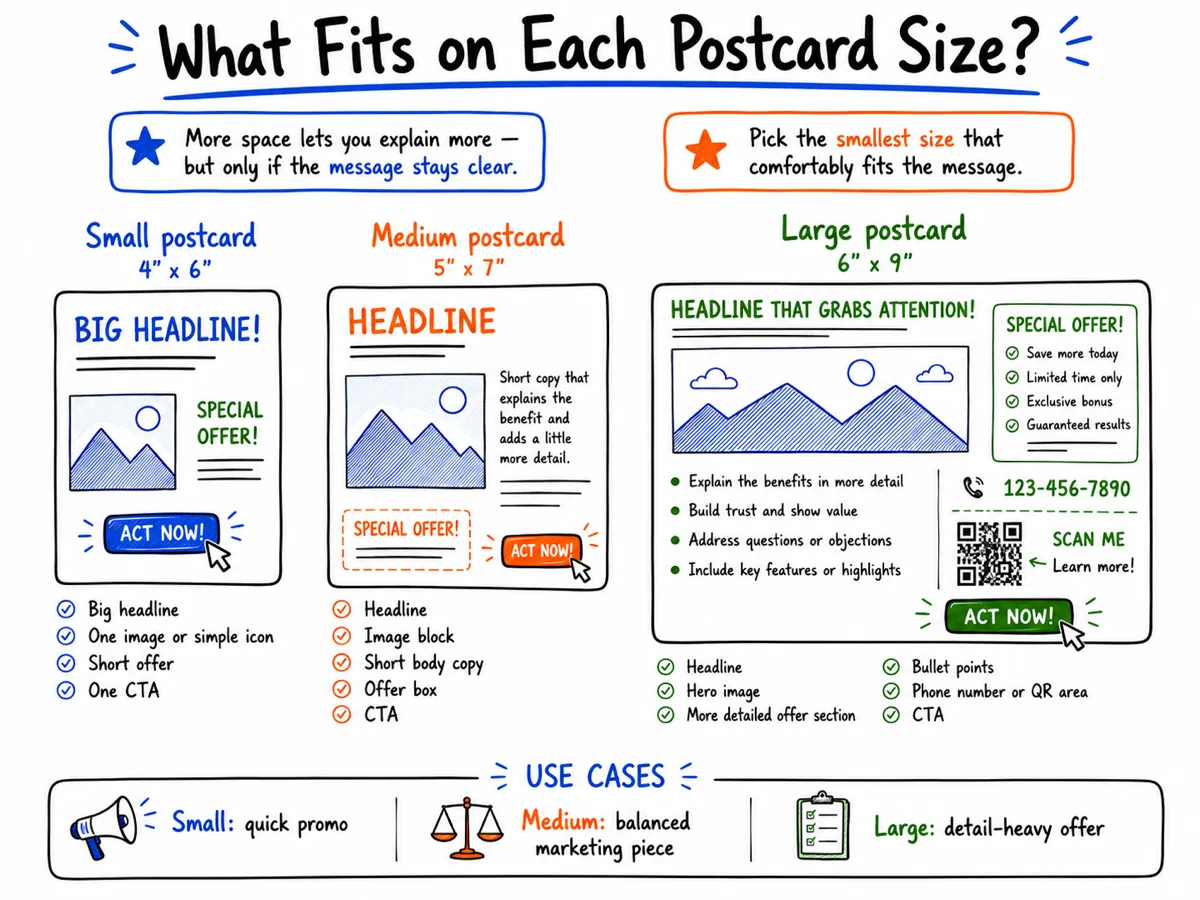
Pick the smallest size that keeps the offer readable and leaves stable room for the address, return address, and required markings. Then check the mail class. Its price category decides the cost as much as the trim size does. Move up a size only when the extra space makes the message clearer.
- 4 × 6 fits a short message: a reminder, one offer, and one call to action.
- 6 × 9 adds room for an image, proof points, and a QR code or tracked URL.
- 6 × 11 gives the most room at letter size, for longer copy or several response options.
- USPS EDDM-eligible sizes (for example 6 × 11, 6.25 × 9, 6.25 × 11, 8.5 × 11) are for saturation mail to every address on a carrier route; confirm the EDDM format shown in your Sendvo account.
| Decision | What to check before print |
|---|---|
| Mail class | Does the size still get the price you budgeted for in this class and preparation (retail, presorted First-Class, Marketing Mail, or EDDM)? |
| Thickness | Does the paper stock fall inside the thickness range for its size category? |
| Message length | Can the headline, offer, and response path fit without shrinking below readable size? |
| Address block | Is there stable space for the recipient address, return address, and any required mail markings? |
| Personalization | Can variable fields expand without breaking the design or hiding the call to action? |
| Proofing | Does the approval workflow show the exact size, front, back, and sample variable data? |
Once the size is set, lock it into a reusable postcard template so the address space, variable fields, and proof versions stay consistent from send to send.
Postcard size FAQ
What size is a standard postcard?
A standard USPS postcard is between 3.5 × 5 inches and 4.25 × 6 inches, and 0.007 to 0.016 inch thick. A 4 × 6 inch card fits inside that range, so it qualifies for the First-Class Mail postcard price when it is rectangular and meets the thickness limits.
Can a 6 × 9 postcard get the postcard price?
Yes, but only as a commercial presorted or automation First-Class Mail postcard that is 0.009 to 0.016 inch thick. Mailed any other way, such as single-piece at a Post Office, a 6 × 9 card is larger than the 4.25 × 6 inch card maximum and pays letter-size postage.
Is a 6 × 11 postcard a letter or a flat?
A 6 × 11 postcard is letter-size. It is no more than 6-1/8 inches high and 11-1/2 inches long, so USPS prices it as a letter. It is too large for any postcard price and, under general USPS rules, too small to count as a flat. EDDM is the exception: for EDDM Retail, USPS accepts pieces longer than 10-1/2 inches, so a 6 × 11 card meets the EDDM Retail length rule. For EDDM BMEU, pieces 10-1/2 to 11-1/2 inches long need an “EDDM” marking after “ECRWSS” (DMM 201.5.2.2).
What size postcard can I send with EDDM?
USPS requires an EDDM Retail piece to be longer than 10-1/2 inches, taller than 6-1/8 inches, or thicker than 1/4 inch, and no more than 15 × 12 inches and 3/4 inch thick. It can weigh up to 3.3 ounces at a Post Office. A 6 × 11 postcard qualifies on length for EDDM Retail; 4 × 6 and 6 × 9 cards do not.
Do square postcards cost more to mail?
Often, yes. A square card falls outside the postcard size range and below USPS’s 1.3 minimum aspect ratio, and USPS treats a letter-size piece with an aspect ratio (length divided by height) below 1.3 or above 2.5 as nonmachinable. First-Class Mail letters with nonmachinable characteristics pay a surcharge.
Sources
- USPS Postal Explorer, Business Mail 101: Postcards: First-Class card minimum and maximum, rectangular shape, and USPS Marketing Mail card limits.
- USPS Postal Explorer, Business Mail 101: Letters: letter-size range and the First-Class nonmachinable surcharge.
- USPS Postal Explorer, Business Mail 101: Flats: flat-size range and how USPS measures length and height.
- USPS Domestic Mail Manual 201: Physical Standards for Commercial Letters, Flats, and Parcels: 6 × 9 commercial postcard maximum, card material, aspect ratio, and 0.009 inch thickness rule.
- USPS Domestic Mail Manual 101: Physical Standards for Retail Mail: letter and flat dimensions, nonmachinable aspect ratio, and flat flexibility, corner, and uniform-thickness rules.
- USPS PostalPro: Larger Sized Postcard FAQs: 6 × 9 maximum for commercial presorted or automation First-Class postcards and the 0.009–0.016 inch thickness range.
- USPS: Every Door Direct Mail: EDDM flyers, postcards, and flats as USPS Marketing Mail, the 3.3 ounce limit, and the Mailpiece Size Checker.
- USPS Every Door Direct Mail Quick Reference (PDF): EDDM flat dimensions (over 10-1/2 in long, over 6-1/8 in high, or over 1/4 in thick; maximum 15 × 12 × 3/4 in), minimum thickness and height, longest side as length, and the 3.3 ounce retail limit.
- USPS Domestic Mail Manual 143: Every Door Direct Mail-Retail: EDDM Retail flat dimensions, the 3.3 ounce weight limit, and quantity rules.
- Sendvo pricing: published Local Standard Class and EDDM rates.
Update history: 2026-09-23, rebuilt around standard postcard sizes, USPS card, letter, and flat thresholds, EDDM sizes, and Sendvo's published rates. 2026-06-18, first published.